LOST ISLAND JOURNAL / FROM THE ARCHIVE
Mining in Space
Originally published
You may recall a news item from a few years ago about a planet where it rains rubies and sapphires. The distant exoplanet in question carries the catchy moniker HAT-P-7b, and it’s a so-called “hot Jupiter” approximately 16 times the size of Earth. Although it’s appealing to imagine harvesting precious gems from the clouds, the planet’s location—roughly 1000 light years from Earth—as well as its environmental conditions—surface temperatures in excess of 2500 degrees Celsius—make any kind of mining there virtually impossible.
Luckily, you don’t need faster-than-light travel to reach other valuable resources in space. Scientists have long known that precious metals like platinum, iridium, and gold are found in significant quantities in meteorites, and mining these materials from near-Earth asteroids has been fodder for Sci-Fi writers for decades now. The recent boom in private commercial space flight seems like a significant step toward making this a reality, but it turns out that the real money may be in mining a much simpler resource. "Everyone's starting to realize that water will be the oil of space industrialization," says Dr. Joel Sercel, one of the new breed of space entrepreneurs working to make mining in space profitable.
Sercel’s company, TransAstra, is one of the many firms looking to mine water from the moon’s polar ice reserves. While extracting water is key to providing life support for human habitation on the moon, it may be more profitable to break it into hydrogen and oxygen. These elements are primary ingredients for the propellant that powers rockets, making refueling in space viable. At this point, it seems likely that the first viable commercial space venture will result in a lunar gas station.
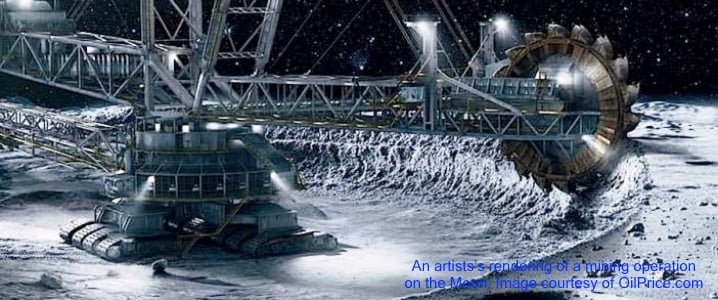
To that end, NASA has recently approved TransAstra’s proposed Lunar-Polar Propellant Mining Outpost (LPMO) for further study. The LPMO won’t look like a terrestrial mining operation—there will be no tall drilling rigs or huge machinery removing overburden to reach deposits of water. Instead, Sercel plans to use radiation as his primary tool to harvest the vast stores of ice found in craters at the lunar poles. The floors of these craters are in perpetual shadow, but at the rim there is nearly continual sunlight. The LPMO will use this sunlight to generate electricity which will power automated rovers down in the crater. The rovers will vaporize the ice beneath them with microwaves and infrared light, then capture the released vapor in “cryotraps”.
Other companies also plan to use sunlight to extract water from asteroids. A team led by Dr. George Sowers at the Colorado School of Mines has also received NASA funding to explore “thermal mining”—using redirected sunlight to extract the water trapped in regolith (the loose, uncompacted dust and crushed rock the covers the moon and many asteroids). Like the LPMO model, the plan is to vaporize the ice and capture the resulting moisture as it rises.
These projects are not just pipe dreams—the White House is taking steps today to bring space mining to fruition. On April 6th, 2020, the POTUS signed the “Executive Order on Encouraging International Support for the Recovery and Use of Space Resources” in order to formalize US policy on the retrieval and use of extraterrestrial natural deposits. The order asserts that the US has the right to use such resources without the need for international treaties or oversight, but encourages international partnerships with other spacefaring nations.
Here at the Planetary Broadcast Network, we look forward to the day when we can refuel our ship at a lunar truck stop. Nothing could be more American than buying a 64oz cup of your favorite Jibble Juice while filling up the tank!
THERE’S ALWAYS MORE OUT THERE.
Explore our worlds