LOST ISLAND JOURNAL / FROM THE ARCHIVE
Big-brained Apes
Originally published
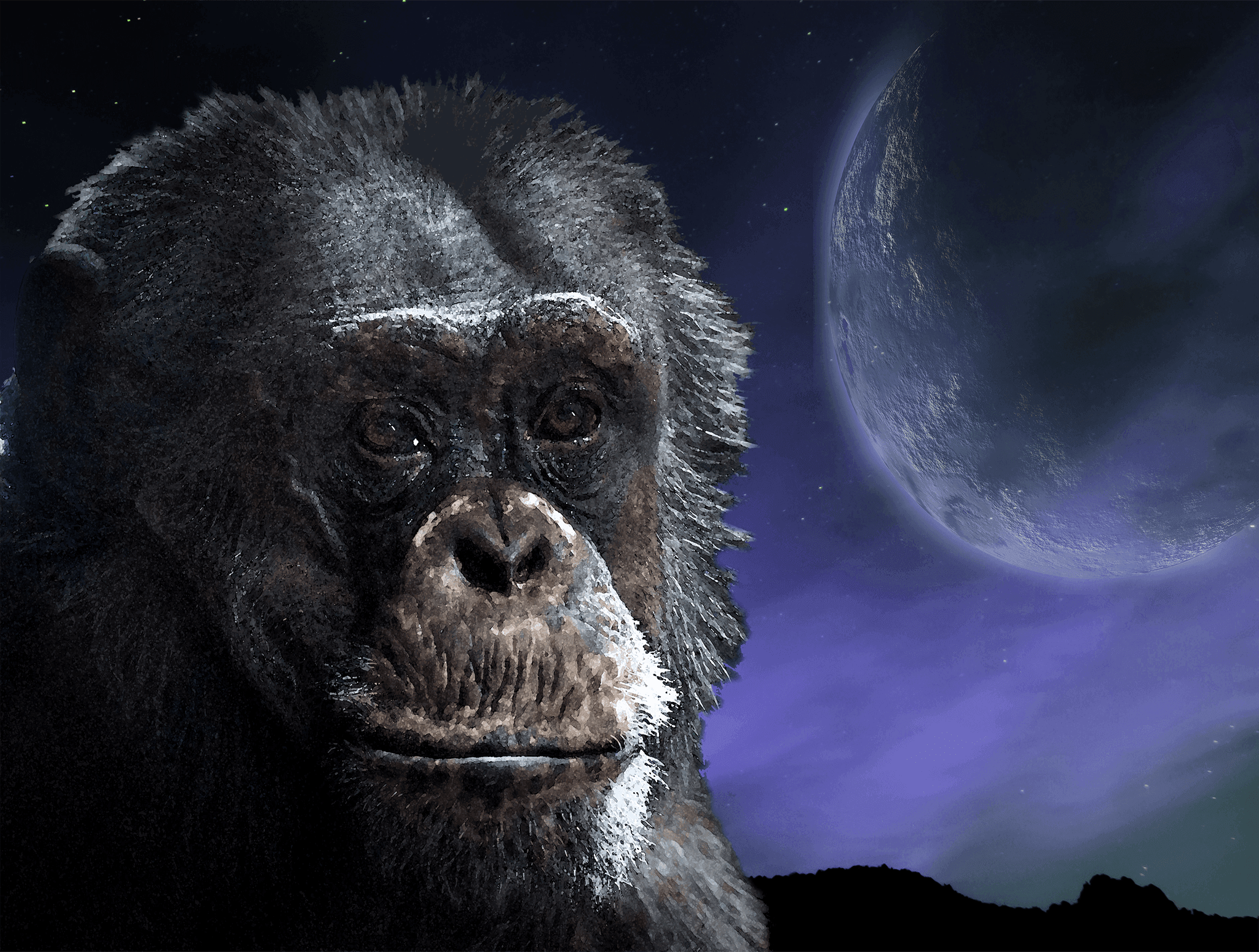
In 1758, Swedish physician and father of modern taxonomy, Carl Linnaeus, named the species to which we all belong Homo sapiens. Since then, other taxonomists have suggested there isn’t sufficient difference between the genera Homo and Pan (the genus of the chimpanzee and bonobo), arguing that we should really be called Pan sapiens. Under either naming scheme, the thing that sets us apart from our great ape cousins is the development of our brains. Sapiens translates as “wise” or “astute” but the more quantifiable measure is the sheer capacity of our brain case as compared to those of chimps or gorillas. On average, the human brain is two to three times the size of our closest relative, the Pan troglodytes chimpanzee. In addition, our cerebral cortex holds twice as many cells as the same structure in chimps.
How we grow these large brains is the subject of a recently published study led by Dr Madeline Lancaster, from the Medical Research Council Laboratory of Molecular Biology, in Cambridge, England. During the earliest stages of embryonic brain development, neurons are manufactured by a type of stem cell known as neural progenitors. The more times these cells divide at this early stage, the more neurons the organism will eventually have. Lancaster’s team discovered that in other mammalian species like mice, these cells mature, change shape, and slow their rate of division within hours, while in chimps and gorillas, this maturation takes around five days to complete. In humans, it can take seven days or longer. Human progenitor cells are also larger and divide more often, resulting in a greater number of neurons.
The researchers identified the gene ZEB2 as the metabolic “switch” for this maturation process. When the ZEB2 gene was activated early in human progenitor cells, it caused them to mature and stop dividing sooner, and the resulting cells resembled those of great apes. Applying this information to ape cells, they found that delaying the activation of ZEB2 in chimp and gorilla cells caused their progenitors to continue dividing and producing neurons longer; in short, they behaved more like human progenitor cells. Although this research is nascent, it points again to the intriguing possibilities presented by stem cells and genetic manipulation. In addition to potential preventions and treatments for a host of degenerative brain conditions, this finding also suggests that control of ZEB2 could prolong and enhance the productivity of progenitor cells, building brains with larger and more dense concentrations of neurons in the cerebral cortex.
We contacted our senior consultant on primate issues, Dr. Bubbles, for comment on this study. In a measured response, Bubbles, now the chair of Simian Intelligence at UCLA, agreed that this is an important breakthrough, but cautioned against jumping to conclusions. “Tinkering with the chemistry that controls brain development is certainly a tantalizing prospect,” wrote the distinguished chimpanzee scholar. “But the ethics of it are quite fraught. As is often the case with scientific developments, we may have the ‘how’ of the issue in hand, but the ‘why’ is another matter. It would be terrible for all involved if an unscrupulous government or corporate entity would, for example, use this discovery to begin the wholesale creation of less intelligent human drones for menial or dangerous work, biological research, organ harvesting, etc. Worse yet, I believe, is the prospect of an enhanced simian population. This is not simple self-preservation—I believe that were there many more like me, they would suffer greatly, as I have, being thrust into the awareness that is the curse of humanity, but in larger numbers they would be relegated by society to demeaning roles far beneath what a mind so awakened craves. Either way, we are left with something akin to Huxley’s World State, but lacking the soothing soma to keep it peaceful.”
Are you thinking what I’m thinking? Sure, we need to be careful like Bubbles said, but…super-intelligent gorilla soldiers really sound like a great idea! For more developments in this story, and all the news you need to be an informed participant in our great democratic experiment, stay tuned to the Planetary Broadcast Network.
THERE’S ALWAYS MORE OUT THERE.
Explore our worlds